Robust MPC
LinearMPC.jl can handle uncertaintiy in the system dynamics and in the current state.
Uncertainty in the dynamics
Model predictive control requires a model of the system dynamics. In practice, there is often a mismatch between this model and the true dynamics. This mismatch can be captured with an additive disturbance $w_k$ in the dynamics
\[x_{k+1} = F x_k + G u_k + w_k.\]
If the mismatch is no accounted for, constraints that are predicted to be satisfied might now be so in practice. We illustrate this with the following example of the control of a double integrator.
using LinearMPC, Plots

F, G = [1 0.1; 0 1], [0.005; 0.1;;]  # double integrator with Ts=0.1
true_dynamics = (x, u, d) -> F*x + G*u + 0.01*(rand(2) .- 0.5)

mpc_nominal = LinearMPC.MPC(F, G; Ts=0.1, Np=25, C=[1 0;])
set_bounds!(mpc_nominal; umin=[-0.2], umax=[0.2], ymin=[-0.5], ymax=[0.5])

sim_nominal = Simulation(true_dynamics, mpc_nominal; r=[0.5])
hline([0.5], label="Constraint bound", linestyle=:dash)
plot!(sim_nominal.ys[1,:], xlabel="Time step", ylabel="Position [m]", label="Nominal MPC")
import numpy as np
import matplotlib.pyplot as plt
from lmpc import MPC, Simulation
F = np.array([[1, 0.1], [0, 1]])
G = np.array([[0.005], [0.1]])
true_dynamics = lambda x, u, d: F @ x + G @ u + 0.01 * (np.random.rand(2) - 0.5)
mpc_nominal = MPC(F, G, C=np.array([[1, 0]]))
mpc_nominal.set_bounds(umin=[-0.2], umax=[0.2], ymin=[-0.5], ymax=[0.5])
sim_nominal = Simulation(mpc_nominal, f=true_dynamics, r=[0.5])
plt.axhline(0.5, linestyle="--", label="Constraint bound")
plt.plot(sim_nominal.ys[0, :], label="Nominal MPC")
plt.xlabel("Time step"); plt.ylabel("Position [m]")
plt.legend(); plt.show()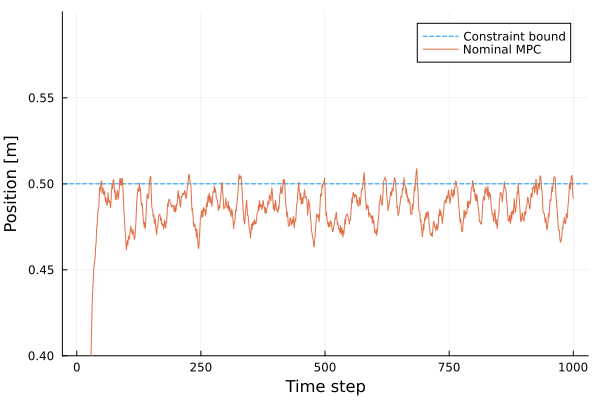
As the plot shows, the constraint $x_1 \leq 0.5$ is violated due to the model mismatch.
To account for model mismatch, the function set_disturbance!(mpc,wmin,wmax) defines upper and lower bounds on the process noise, and then tightens the constraints to ensure that the original constraint is satisfied (as long as the actual disturbance $w$ is between wmin and wmax.
Doing this a priori constraint tightening is superior to many commonly used tube MPC approaches.[Zanon21].
mpc_robust = LinearMPC.MPC(F, G; Ts=0.1, Np=25, C=[1 0;])
set_prestabilizing_feedback!(mpc_robust)
set_disturbance!(mpc_robust, [-0.005; -0.005], [0.005; 0.005])
set_bounds!(mpc_robust; umin=[-0.2], umax=[0.2], ymin=[-0.5], ymax=[0.5])

sim_robust = Simulation(true_dynamics, mpc_robust; r=[0.5])
plot!(sim_robust.ys[1,:], label="Robust MPC")
mpc_robust = MPC(F, G, C=np.array([[1, 0]]))
mpc_robust.set_prestabilizing_feedback()
mpc_robust.set_disturbance([-0.005, -0.005], [0.005, 0.005])
mpc_robust.set_bounds(umin=[-0.2], umax=[0.2], ymin=[-0.5], ymax=[0.5])
sim_robust = Simulation(mpc_robust, f=true_dynamics, r=[0.5])
plt.plot(sim_robust.ys[0, :], label="Robust MPC")
plt.legend(); plt.show()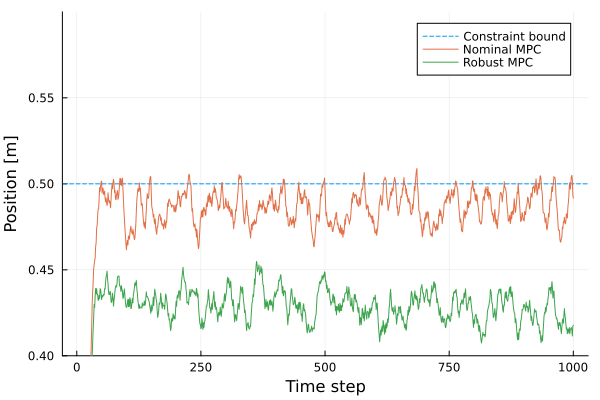
By constructing an MPC mpc_robust, we see that the constraint are satisfied despite the disturbance $w$. One can see that the resulting response is quite conservative. This is because the constraint are tightened to handle the worst-case noise realization. For the example and scenario in question, the worst-case disturbance is for ${w = \left(\begin{smallmatrix}0.005 \\ 0.005 \end{smallmatrix}\right)}$. If we rerun the simulations for the worst-case disturbance, we get a large violation for mpc_nominal, while mpc_robust still manages to fulfill the constraints.
worst_case_dynamics = (x, u, d) -> F*x + G*u + 0.005*ones(2)
sim_nominal_wc = Simulation(worst_case_dynamics, mpc_nominal; r=[0.5])
sim_robust_wc  = Simulation(worst_case_dynamics, mpc_robust;  r=[0.5])
hline([0.5], label="Constraint bound", linestyle=:dash)
plot!(sim_nominal_wc.ys[1,:], xlabel="Time step", ylabel="Position [m]", label="Nominal MPC")
plot!(sim_robust_wc.ys[1,:],  label="Robust MPC")
worst_case_dynamics = lambda x, u, d: F @ x + G @ u + 0.005 * np.ones(2)
sim_nominal_wc = Simulation(mpc_nominal, f=worst_case_dynamics, r=[0.5])
sim_robust_wc = Simulation(mpc_robust, f=worst_case_dynamics, r=[0.5])
plt.axhline(0.5, linestyle="--", label="Constraint bound")
plt.plot(sim_nominal_wc.ys[0, :], label="Nominal MPC")
plt.plot(sim_robust_wc.ys[0, :], label="Robust MPC")
plt.xlabel("Time step"); plt.ylabel("Position [m]")
plt.legend(); plt.show()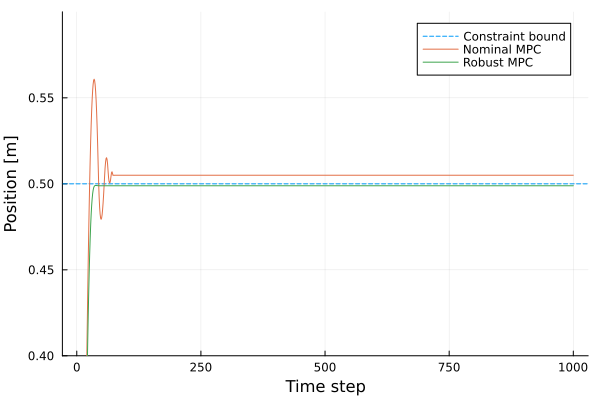
Note that if the disturbance $w$ is measurable/known, it can be accounted for without having to tighten the constraints by providing it as a measurable disturbance $d$ (see Model for details.)
Uncertainty in the current state
Uncertainty in the current state can also be handled robustly. If the current state $\hat{x}$ is assumed to be in the box
\[-\delta \leq x - \hat{x} \leq \delta,\]
constraints can be tightened with
set_x0_uncertainty!(mpc,delta)mpc.set_x0_uncertainty(delta)- Zanon21Zanon, Mario, and Gros, Sébastien. "On the similarity between two popular tube MPC formulations." European Control Conference (ECC) (2021)